Family Tilapia Farming Unit Part 2
From sowing to the table: care for, harvest and start over with your tilapia
Your fingerlings are already swimming and eating. Now comes the part that turns a tank of fish into food for your family: caring for the water, harvesting at just the right time and leaving the system ready for the next cycle. It is not complicated: it is about measuring, watching and acting in time. This article gives you everything you need so nothing catches you by surprise.
Monitor the water
Water speaks, and the testing kit is like listening to it. Five minutes of measuring warns you of a problem days before your fish suffer from it. That is the difference between a harvest and a loss.
The testing kit
- pH meter, reagents for ammonia, nitrites and nitrates, submersible thermometer and dissolved oxygen meter.
- Always follow the manufacturer's instructions for each instrument or reagent.
Water parameters
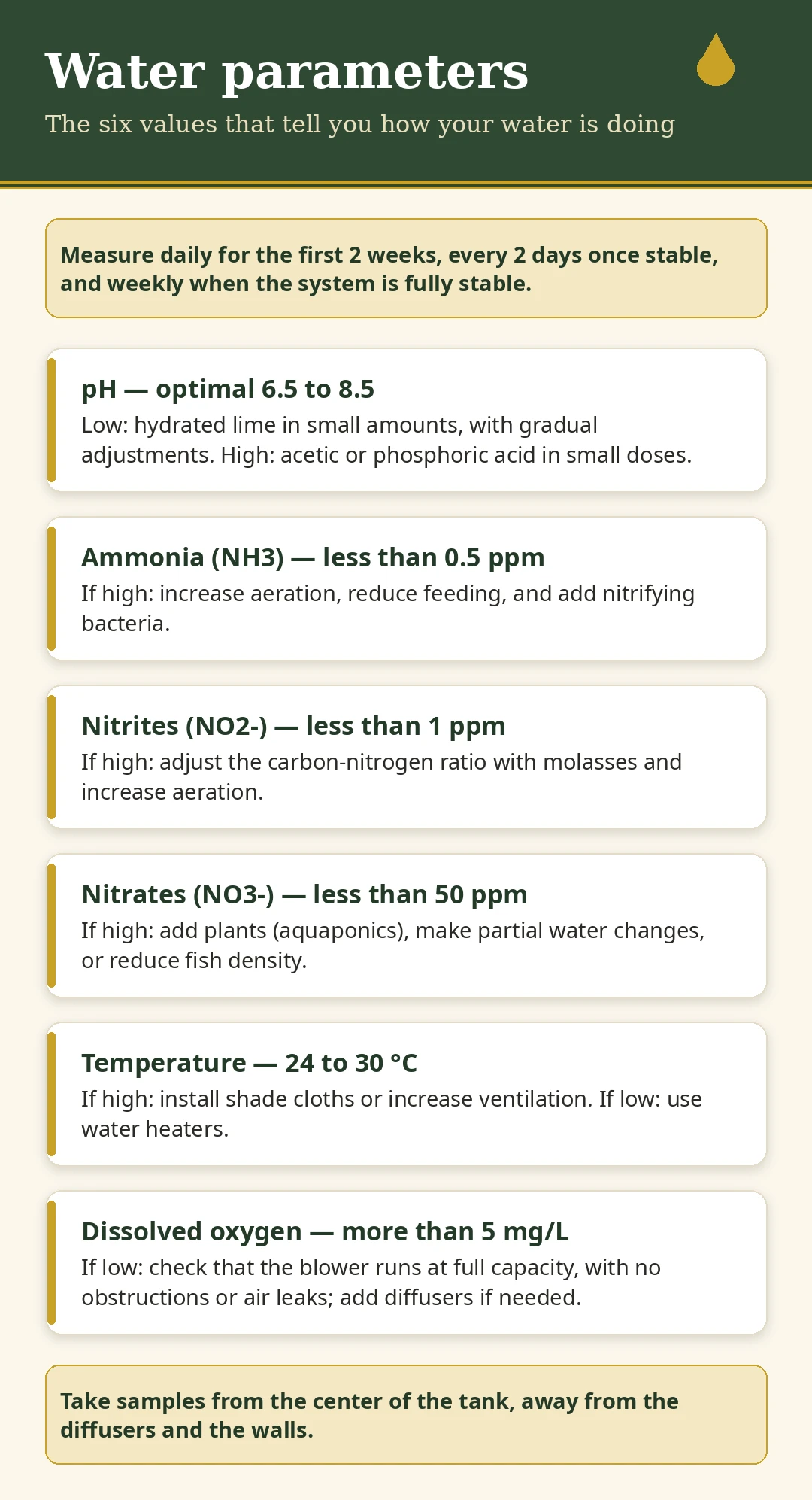
The six parameters, their optimal ranges, what to do if any of them goes out of range, and how often to measure are all brought together in the visual guide below. If you use hydrated lime to raise the pH: wear gloves, and do not inhale the dust.
Check this visual reference during your inspections.
Data log
At each measurement, note the date and time, the pH, ammonia, nitrite, nitrate, dissolved oxygen and temperature readings, and additional observations: fish behaviour, water clarity or colour, and any adjustment made (lime, ferments, etc.). A standard log lets you spot trends and act before a problem gets worse.
Print and reuse this tracking sheet: it has 16 blank rows and the optimal ranges in a gold row. Download the water measurement log (printable PDF).
To keep the system stable
- Check the water pump and the aeration system regularly.
- Clean the filters weekly.
- Do not overfeed: give only what the fish eat within a few minutes.
- Adjust the carbon-nitrogen ratio according to the testing kit values.
- In the long term, if nitrates keep rising, reduce the fish load or add plants; and as the fish grow, adjust the amounts and types of feed so as not to overload the system.
Harvest and next cycle
This is the moment you waited 6 to 8 months for: protein raised by you, at home, for your table. Harvesting well is as important as raising well: poor handling at harvest ruins months of good work.
When to harvest
- Tilapia reach an average weight of 500 grams to 1 kilogram after about 6 to 8 months.
- Harvest when at least 80% of the fish reach market size.
- Before harvesting, check that the water parameters are within the recommended ranges: fish stressed by poor water conditions are lower quality.
Preparation
- Stop feeding 24 hours before the harvest: it empties the fish's gut and improves the meat quality.
- Make sure all the equipment you need is clean and in good condition (nets, containers, scales, etc.).
Harvest
- Use soft nets to catch the fish, avoiding sudden movements that could injure them or affect the meat quality.
- Separate the fish that have not reached the right size yet and return them to the tank so they keep growing.
- Work quickly: the fish should not spend too long out of the water. Keep the harvested fish in fresh water until you process or store them.
Slaughter
- Ice immersion: the most common and effective method. Submerging the fish in ice water gradually reduces their activity and leads them to a quick death without suffering.
- Blow to the head: for small batches, a quick, precise blow to the head causes immediate death.
Handling and storage
- Wash the fish immediately after harvest with cold, clean water, to remove dirt or biofloc from the skin.
- If you do not process them right away, place them on ice or under refrigeration to keep them fresh and prevent bacteria from multiplying.
- Refrigeration: the fish stay fresh between 0 °C and 4 °C for up to 3 days.
- Freezing: at -18 °C or below, they store for several months without losing significant quality.
Preparing the next cycle
- Remove the sediment and biofloc remains from the bottom of the tank, with suitable tools that do not damage the system.
- Take apart and thoroughly clean the filters with chlorine-free water. Do not use detergents or harsh chemicals: they would harm the beneficial bacteria of the next cycle.
- Check the equipment: the water pump and aeration should run without obstructions or loss of power, and the pH, dissolved oxygen and temperature sensors should be calibrated.
- If needed, restart the water maturation (chapter 3 of the first article) to re-establish the nitrifying bacteria before adding new fingerlings. Before stocking them, check that the parameters are within the optimal ranges.
- Do preventive maintenance on the equipment between cycles: it reduces the risk of failures and extends its working life.
- Record the harvest: date, number of fish harvested, total weight and observations on quality. It lets you assess the cycle's productivity and improve the next ones.
Problems and solutions
Almost everything that can go wrong in a biofloc system announces itself before it arrives: the fish tell you with their behaviour and the kit confirms it with numbers. Here are the most common problems, how to recognise them and what to do. Keep this section at hand: it is the one you will check when something does not look right.
- High ammonia. Signs: lethargic fish, rising to the surface for oxygen, spots on the gills. Likely cause: excess feeding, insufficient aeration or too few nitrifying bacteria. What to do: increase aeration, reduce feeding and add nitrifying bacteria.
- High nitrites. Signs: lethargy, reddened fins, swollen gills. Likely cause: lack of nitrifying bacteria or excess ammonia. What to do: adjust the carbon-nitrogen ratio with molasses or a carbon source; increase aeration.
- High nitrates. Signs: at low levels they are not toxic; above 50 ppm they affect growth. Likely cause: excess feeding or lack of plants or absorption mechanisms. What to do: add plants (aquaponics), make partial water changes or reduce fish density.
- Unstable pH. Signs: stress, loss of appetite, reduced growth. Likely cause: changes in alkalinity, build-up of organic waste or untreated water. What to do: adjust gradually: hydrated lime in small amounts if it is low; acetic or phosphoric acid in small doses if it is high. Measure the pH daily.
- Low dissolved oxygen. Signs: fish rising to the surface to breathe, lethargy, loss of appetite. Likely cause: insufficient aeration, too many fish or biofloc build-up. What to do: increase aeration (more diffusers or more blower power); siphon off some of the excess biofloc.
- Bacterial infection. Signs: skin lesions, eroded fins, bulging eyes, ulcers. Likely cause: poor water quality or external pathogens. What to do: improve the water quality with a full parameter analysis. If the infection is severe, consult a specialised veterinarian to apply specific antibiotics.
- Fungi. Signs: cottony patches on the skin or fins. Likely cause: poor-quality water or injured fish. What to do: add aquarium salt in the proportion recommended by the manufacturer. Improve aeration and cleaning.
- Parasites. Signs: fish scraping their bodies against the tank walls, lethargy, visible parasites. Likely cause: infected fingerlings or external contamination. What to do: isolate the affected fish and treat them in a separate tank. Disinfect the tank with approved treatments and clean the filters and pipes.
- Water pump failure. Signs: no circulation, sediment build-up, deteriorating water quality. Likely cause: obstructions, motor wear or electrical problems. What to do: disconnect and clean the pump; if needed, take apart and clean the internal components. If the wear is irreversible, replace it with one of equal or greater capacity.
- Aeration failure. Signs: fewer air bubbles, fish breathing at the surface, biofloc build-up. Likely cause: clogged diffusers or a faulty blower. What to do: check that the blower runs at full capacity and that there are no air leaks in the pipes. Remove and clean the clogged diffusers.
- Stress. Signs: fish crowded in a corner, erratic swimming or staying at the bottom of the tank. Likely cause: sudden changes in water quality, overcrowding or poor handling. What to do: check all the water parameters and adjust as needed. Avoid handling the fish unnecessarily and do not overcrowd the tank.
Costs and solar kit
Approximate investment
Building the complete system costs, in very rounded figures, between 700 and 900 dollars (USD, reference prices in the United States). It is not an exact budget: prices vary by store, region and whether you buy new or reconditioned. It serves to get an idea before starting.
- Main 1000-litre tank, food-grade, new: about 300 dollars (usual range 250 to 450).
- Aeration blower: about 50 dollars.
- 12 V submersible pump, 2000 litres per hour: about 30 dollars.
- Filters in series (containers, K1 bio balls, mesh): about 100 dollars.
- 3-inch PVC pipes and fittings: about 75 dollars.
- Reservoir (bucket of about 20 litres): about 10 dollars.
- Water testing kit: about 40 dollars.
- Diffusers, hoses and valves: about 30 dollars.
- Fingerlings (about 60 to 80) and starter feed: about 100 dollars.
The biggest expense is the tank. A reconditioned tank lowers the total, but it must be food-grade and must never have held chemicals. On top of that come the monthly electricity use and the feed for each cycle. The system pays for itself in protein: between 60 and 80 tilapia per cycle of 6 to 8 months.
Solar kit (optional)
The system can run on solar energy, but aeration can never stop: without oxygen the fish die within hours. That is why the solar kit is not just a panel, it is panel plus battery.
- Consumption: the blower uses less than 30 W and the pump about 30 W (2000-litres-per-hour class), both running 24 hours a day. In total, about 60 W continuous, that is, about 1.4 kWh per day.
- Solar panel: at least 400 W (for example, one 400 to 500 W panel or two 200 W panels). With about 4 to 5 hours of full sun a day in California, a 400 W panel generates what the system uses, with margin for cloudy days and losses.
- Battery: at least 12 V and 100 Ah (better 200 Ah) to get through the night and a cloudy day without the aeration stopping. In lithium (LiFePO4), 100 Ah deliver more than 100 Ah of lead-acid, which should not be discharged more than halfway.
- MPPT charge controller between the panel and the battery.
- If your blower runs on alternating current (110 V), you also need a pure sine wave inverter of at least 300 W; the 12 V pump can connect directly to the battery.
- Before buying the kit, check the label on your pump and your blower and confirm their real watts: if they use more than assumed here, scale up the panel and the battery in the same proportion.
Frequently asked questions
- How much electricity does the system use? It depends on the equipment, but the blower, at less than 30 W, uses less than 0.72 kWh a day running 24 hours; on top of that comes the 12 V submersible pump, also low-consumption. The exact total consumption depends on the models you install.
- How much does it cost to build the system? In very rounded figures, between 700 and 900 dollars. The biggest expense is the 1000-litre tank.
- How much space do I need to install the system? An area of about 3 by 3 metres is enough for the tank and the filters.
- How often should I clean the filters? Every week for filter 1 (settler) and 2 (mechanical). The biofilter (filter 3) is only checked after each harvest, without removing the bio balls.
- How do I know if the water is in optimal condition? Check the water parameters with the testing kit weekly and adjust with ferments or products as needed.
- When is the best time to harvest the fish? When they reach the right weight, normally between 6 and 8 months of growth.
- What do I do if I cannot harvest all the fish at the same time? You can harvest in stages, making sure not to overcrowd the remaining tank.
- Is it legal to raise tilapia in my area? It depends on your state and county. In California, aquaculture must be registered with the California Department of Fish and Wildlife (CDFW) and comply with current regulations; see the regulations section at the end of this article and confirm the local requirements before buying fingerlings.
Quick reference
Key numbers
- Tank: 1000 litres (about 264 gallons).
- Fish per cycle: 60 to 80 fingerlings per cycle. Start with 60; with experience, up to 80.
- Cycle: 6 to 8 months; harvest at 500 g to 1 kg, with at least 80% at market size.
- pH: 6.5 to 8.5.
- Ammonia: less than 0.5 ppm.
- Nitrites: less than 1 ppm.
- Nitrates: less than 50 ppm.
- Temperature: 24 to 30 °C.
- Dissolved oxygen: more than 5 mg/L.
- K1 bio balls: 15 to 20 litres.
- Pump: 1000 real litres per hour (100% of the tank volume per hour).
Tasks
- Every day: check that the blower runs and the bubbles spread well in the tank. Feed according to the stage. Watch the fish: they should swim actively. During the first two weeks and during maturation, measure the water parameters daily.
- Every two days: measure the parameters once the system is stable.
- Every week: clean filter 1 (settler) and filter 2 (mechanical). Check the pump and the pipes. Apply the ferments on separate days (for example, Monday Probiotic Ferment, Thursday Honey Ferment). When the system is fully stable, measure the parameters weekly.
- After each harvest: check the biofilter (without removing the bio balls). Clean the tank and filters thoroughly with chlorine-free water. Check and calibrate the equipment. Restart the water maturation if needed.
- Key moments: day 16: water ready for stocking. First 24 hours of the fingerlings: no feed. 24 hours before harvest: stop feeding.
Glossary and regulations
Glossary
- Aquaponics: growing that combines raising fish with growing plants without soil. Fish waste becomes nutrients for the plants, and the plants filter the water.
- Aquaculture: raising and growing aquatic organisms (fish, crustaceans, algae) in controlled environments.
- Alkalinity: the water's ability to neutralise acids. An adequate level helps keep the pH stable.
- Fingerlings: young fish that have not reached maturity yet. In tilapia, they measure between 2 and 5 cm when they are put into the system.
- Ammonia (NH3): toxic compound produced by fish waste. It is converted into nitrates by nitrification.
- Biofloc: technology that uses microorganisms to maintain water quality, reducing water changes and serving as extra feed for the fish.
- K1 bio balls: filter medium with a large surface for the growth of beneficial bacteria that break down ammonia.
- Settling: separation of solids from the water: heavy particles settle at the bottom of a container for removal.
- Ferments: microorganisms added to the water to promote a healthy environment, break down organic matter and improve water quality. In this system there are three: Seed Ferment, Probiotic Ferment and Honey Ferment.
- Biological filtration: process in which nitrifying bacteria convert toxic ammonia into nitrites and then into nitrates, which are less harmful.
- Calcium hydroxide: chemical compound (hydrated lime) used to raise the water pH when alkalinity is low.
- Nitrification: biological process in which bacteria convert ammonia into nitrites and nitrites into nitrates.
- Nitrates (NO3): final product of nitrification. At low levels they are harmless; at high concentrations they affect fish health.
- pH: measure of the water's acidity or alkalinity. An adequate level is essential for fish health and the system's biological balance.
- Settling tank: container where solid particles separate from the water before it moves on to other filters.
Safety
- Connect all electrical equipment (pumps, blower) to outlets with protection against short circuits and electrical faults. Avoid direct contact with water when handling electrical equipment and keep connections away from possible splashes. Inspect cables, plugs and equipment regularly.
- Store chemicals (ferments, fish treatments) in dry, safe places, out of children's reach, with clear labels and following the manufacturer's instructions.
- Place the tank and filters in a safe spot, where no objects can fall on them and where small children cannot reach them unsupervised. Outdoors, protect the system from the weather.
- Wear gloves when cleaning or maintaining the filters and pipes, to avoid injuries and contact with fish waste or chemicals. Avoid corrosive or abrasive products.
- Use the ferments as directed, with clean utensils to avoid contamination.
- Do not overcrowd the tank. Do not take the fish out of the water unnecessarily before harvest: it stresses them. Isolate sick or injured fish to prevent disease from spreading.
- Use medical treatments only when needed and follow the recommended doses. Avoid overusing antibiotics or other chemicals: they affect water quality and fish health in the long term.
Regulations in California
- Aquaculture registration (CDFW): the California Department of Fish and Wildlife requires all aquaculture operations to be registered. Registration is renewed annually and the CDFW carries out regular inspections to verify environmental compliance.
- California Clean Water Act: the system must not pollute local water resources. Biofloc helps comply with it because it minimises water use and discharge.
- California Environmental Quality Act (CEQA): aquaculture projects must assess and mitigate their impact on the natural environment, especially water quality, biodiversity and resource use.
- Animal welfare: fish must be kept in conditions that promote their health and welfare, with proper handling, minimal stress and humane slaughter at harvest.
- California Water Conservation Act: promotes water conservation in all sectors. Biofloc supports that goal by recycling water and minimising waste.
One tank, a little work each week, and 6 to 8 months later your family eats fish raised at home. That is real food independence: not a plan for someday, but a system that already works, that pays for itself in protein and starts over as soon as you harvest. The Family Tilapia Farming Unit is not just a way to raise fish: it is a way for your family to depend a little less on everyone else.